
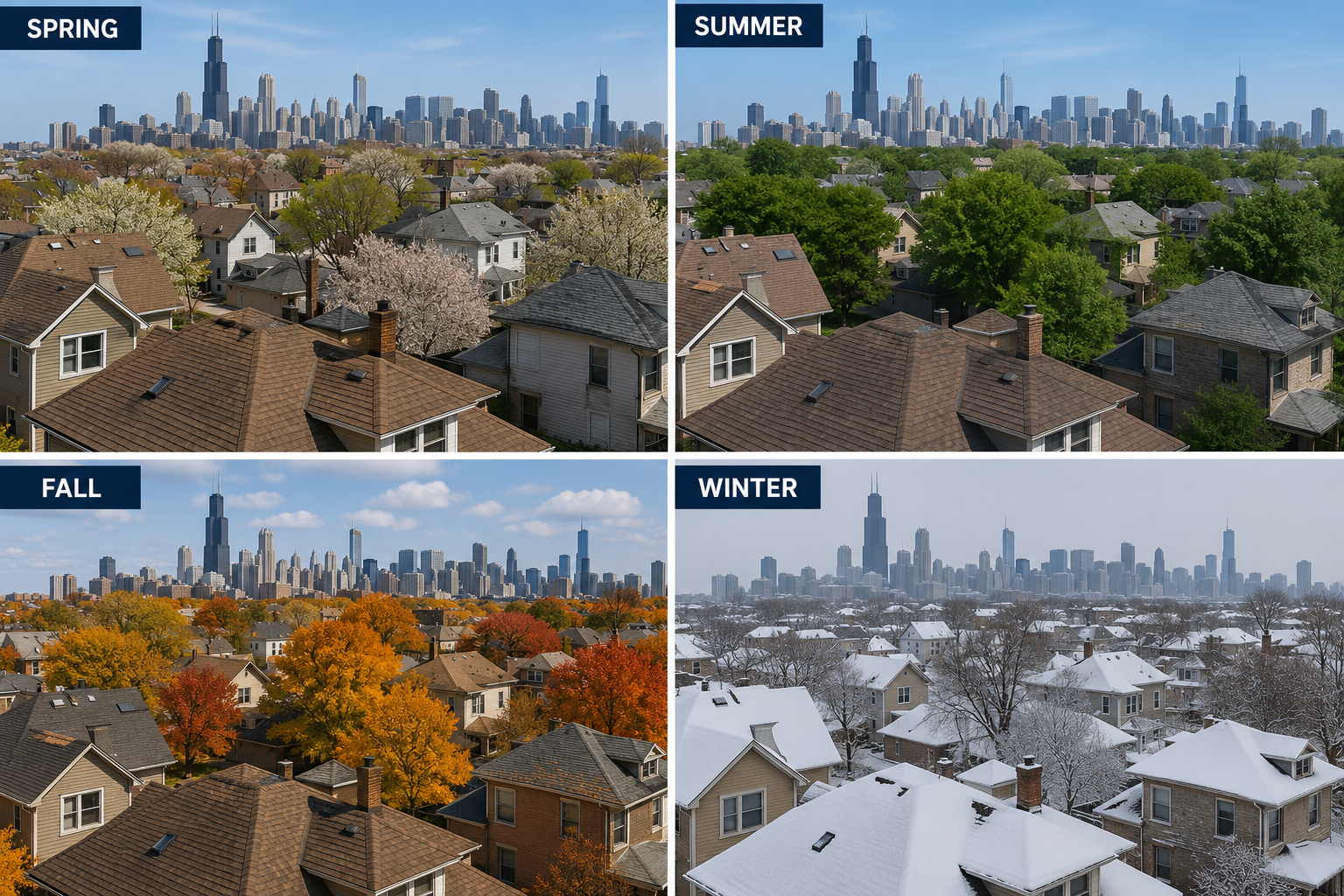
Why’s Chicago weather so brutal on our homes anyway?
Chicago doesn’t just earn its “Windy City” nickname for show. You’re dealing with raw, open-lake air that slams into the city year-round. That means sudden temperature swings, relentless moisture, and enough freeze-thaw cycles to crack even solid masonry over time. Your roof takes the brunt of it all-every season.
And that’s before you factor in how the city’s flat terrain gives storms nowhere to go but straight at your house. There’s no natural buffer. Just wide-open space and a lake that feeds every storm with extra punch.
The truth about those Windy City gusts
Those gusts aren’t just annoying-they’re structural stress tests. Wind speeds along the lakefront regularly hit 40 mph, even in spring. That kind of pressure lifts shingle edges, sneaks under flashing, and wears down seals faster than you’d think. You might not see damage right away, but small gaps grow. Fast.
One mid-sized SaaS firm’s office in Lincoln Park lost half its roof membrane during a fall storm because the contractor skipped wind-rated fasteners. Don’t be that guy.
Dealing with the lake effect snow mess
Lake Michigan doesn’t freeze over completely most winters. That means open water keeps feeding moisture into cold air, dumping heavy, wet snow right over the city and nearby suburbs. You’re not just clearing inches-you’re fighting snow that weighs nearly twice as much as dry powder.
That weight piles up fast on lower slopes and flat sections. Ice dams? They’re not a maybe-they’re a when.
One homeowner in Evanston woke up to a sagging ceiling after three back-to-back storms. The roof held-but just barely. Proper insulation and continuous snow removal are non-negotiable if you want to avoid a collapse or costly repairs down the line.
My take on why asphalt shingles are still king
You see them on nearly every block in Chicago – plain, reliable asphalt shingles holding up against sleet, snow, and summer storms. They’re not flashy, but they get the job done. And they’ve stayed on top for a reason – most homeowners aren’t looking for a showpiece, they want something that works.
Why they’re actually a solid budget pick
Right now, a mid-sized SaaS firm couldn’t outspend you on a metal roof – but asphalt keeps costs manageable. You’re looking at a fraction of the price compared to slate or standing seam metal. That upfront savings adds breathing room for insulation, gutters, or even a rainy-day fund. It’s not about cutting corners. It’s about smart trade-offs.
The real deal on how long they’ll last here
Most asphalt shingles in Chicago last 15 to 20 years – not forever, but not short-lived either. Ice dams, freeze-thaw cycles, and UV exposure all take a toll. But a 30-year architectural shingle, properly vented and installed, can surprise you. We’ve seen them push into the mid-20s with minimal issues.
One south-side bungalow we checked last spring still had original shingles from 2003 – not pristine, but functional. No leaks, no warping, just a little fatigue at the edges. That’s real-world durability, not brochure talk.
Is metal roofing worth the extra cash?
You’re paying more upfront-no doubt about it. But stretch that cost over a 50- to 70-year lifespan and suddenly it doesn’t sting as much. Metal roofs laugh at Chicago’s freeze-thaw cycles, ice dams, and summer storms. They don’t rot, warp, or catch fire. For homeowners planning to stay put, this isn’t an expense. It’s a long game.
Seriously, it’s basically indestructible
Think about the last time hail tore through your neighborhood. While others scrambled for tarps, homes with metal roofs just shrugged it off. Dent-resistant alloys and modern coatings handle impacts most materials can’t. Wind gusts off Lake Michigan? Rated for 140 mph and beyond. This stuff doesn’t flinch.
What’s the catch with the noise and cost?
Yes, rain sounds louder-on a bare metal roof. But your attic has insulation, sheathing, and often a solid underlayment. Once it’s all layered in, the pitter-patter isn’t any worse than other types. As for price? You’re looking at two to three times more than asphalt. That stings at first.
Installation also needs specialized skills. A rookie job means leaks or loose panels. So you can’t cut corners on labor. That precision fit costs more, but skipping it risks everything.
Getting fancy with slate and clay tiles
Slate and clay tiles bring a kind of old-world charm most materials just can’t match. You’ll spot them on historic homes in Lincoln Park or Prairie-style builds in Oak Park – quiet flexes of durability and taste. They laugh at Chicago’s freeze-thaw cycles. Ice, snow, wind – these materials have handled worse for over a century.
Why these look amazing on older Chicago bungalows
That warm, earthy tone of clay tiles? It pairs perfectly with the brick facades of 1920s bungalows. You’re not just roofing a house – you’re restoring a piece of the neighborhood’s soul.
Slate in charcoal or moss green adds quiet elegance. It feels authentic, like it’s always belonged there.
Honestly, your roof might need extra support for these
These materials are heavy – no way around it. A standard roof frame built for asphalt might not handle the load.
Think of it like putting on a winter coat in July – the structure has to be ready.
Before going slate or clay, a structural inspection is non-negotiable. A mid-sized SaaS firm wouldn’t scale servers without checking capacity – same logic here. Your roofer might recommend reinforcement beams or upgraded decking, especially on older builds where wood has settled or weakened over decades.
Final Words
You’ve got options-real ones that stand up to sideways rain, ice dams, and summer heat that turns your attic into an oven. Asphalt’s still the go-to for most Chicago homeowners, and for good reason: it’s reliable, affordable, and gets the job done without drama.
But if you’re planning to stay in your home long-term, metal or even slate might make sense-especially on a roof that sees 30 years of lake-effect winters. Your roof isn’t just curb appeal. It’s the one thing keeping snowmelt and spring thunderstorms out of your living room. Choose like you plan to stay. Because you do.
FAQ
Q: Why do asphalt shingles last longer in Chicago now compared to 10 or 15 years ago?
Manufacturers have seriously upgraded the formula. Today’s architectural asphalt shingles use a fiberglass base that resists warping and moisture far better than older organic versions. They’re coated with tougher asphalt and packed with higher-quality mineral granules that fight UV damage. So when you see hail bouncing off or snow piling up, the shingle isn’t just sitting there-it’s actively holding its shape and shedding water. A mid-sized SaaS firm might upgrade its software every few years, but your roof? It’s getting smarter and tougher too.
Q: I’ve heard metal roofs can be noisy during hailstorms-how true is that?
It’s a common worry, but most modern metal roofs aren’t loud at all. The noise myth comes from old barns or sheds with thin metal and no insulation underneath. Today’s residential metal roofing is installed over solid decking and often includes an underlayment that absorbs impact. So when those hard Chicago hailstones hit, you’ll hear a muffled tap-not a drum solo. And if you’re already using ceiling fans or playing music, you probably won’t notice it at all.
One homeowner in Lincoln Park told me they barely heard a thing during a major storm-while their neighbor’s older asphalt roof had granules all over the driveway.
Q: Can slate or clay tiles handle Chicago’s freeze-thaw cycles?
Yes-but with a big caveat. Natural slate is incredibly durable and can last over 100 years if installed right. Clay tiles are strong too, but they’re more vulnerable to cracking when water sneaks into tiny pores and freezes. That’s why proper flashing and ventilation matter so much. You can’t just slap them on and walk away. A house in Evanston with 1920s-era clay tiles is still going strong, but only because it’s had consistent maintenance and a skilled roofer checking for micro-cracks every few years. So if you love the look, go for it-but budget for long-term care, not just the upfront cost.
